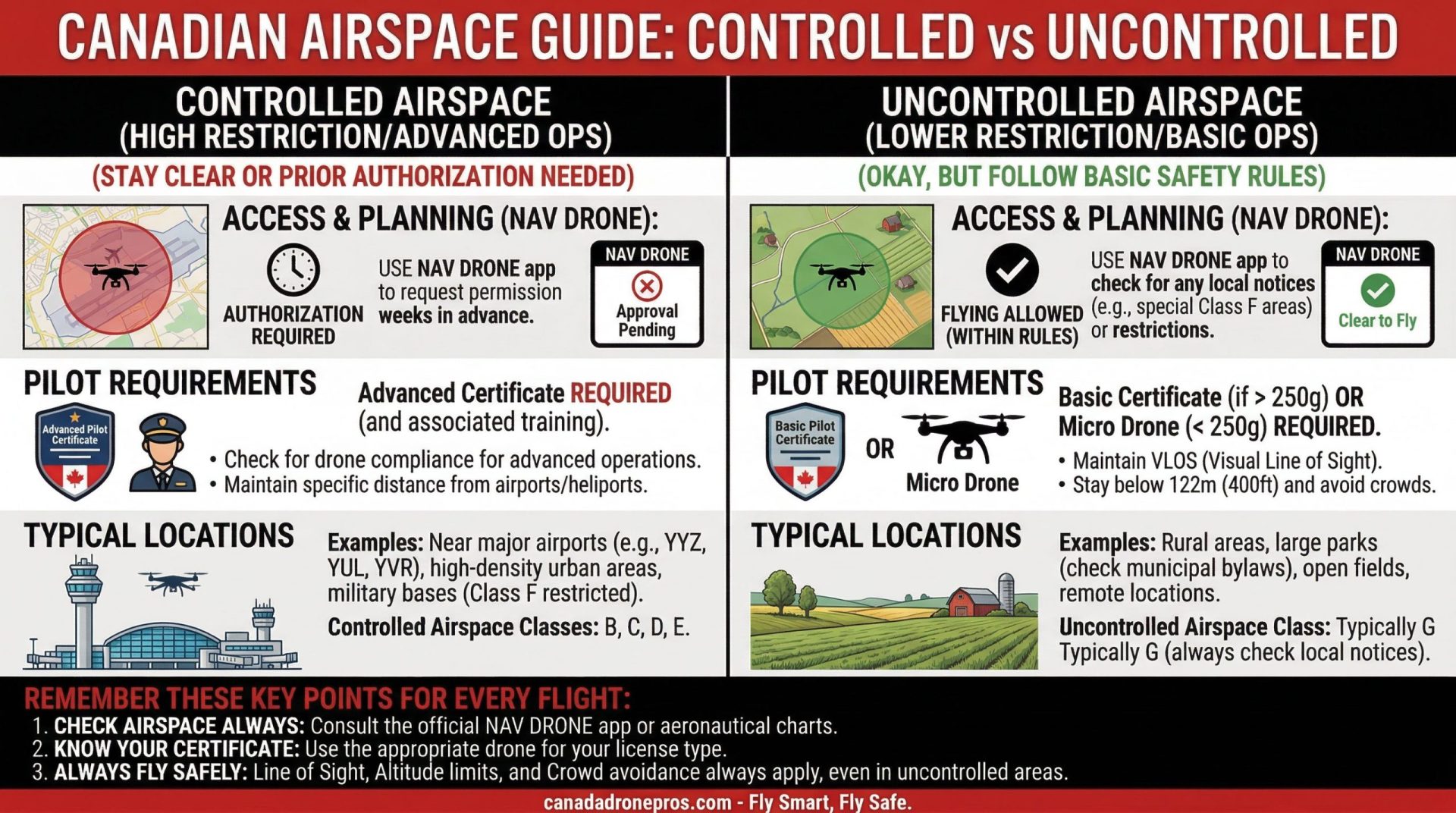
Uncontrolled vs Controlled Airspace in Canada: What Every Drone Operator Needs to Know
The subject we love to hate. Airspace is one of the most misunderstood topics among Canadian drone operators. Many pilots can fly a drone skillfully, understand camera settings, and even pass their exams, yet still feel uncertain when it comes to questions like:
- What exactly is controlled airspace?
- Why do Advanced operations matter so much in certain areas?
- Can Basic pilots ever fly near airports?
- How does NAV CANADA authorization actually work?
- What mistakes get drone pilots fined or grounded most often?
This article exists to answer those questions clearly and thoroughly.
In Canada, drone operations are regulated under Part IX of the Canadian Aviation Regulations (CARs). These regulations establish a risk-based system where airspace classification, pilot certification, and operational privileges are tightly linked. Understanding the difference between controlled and uncontrolled airspace, and how it relates to Advanced operations, is not optional if you want to fly legally and confidently.
This guide will walk you through everything you need to know, step by step, without assuming prior aviation knowledge. And it comes with a bonus FREE Cheat Sheet!
Understanding Airspace: The Foundation of Drone Law in Canada
Airspace is the invisible three-dimensional space above the Earth that aircraft operate within. In Canada, all airspace is regulated by Transport Canada, with air traffic services provided by NAV CANADA.
For drone pilots, airspace determines:
- Where you can fly
- What certification you need
- Whether authorization is required
- How close you can operate to people, aircraft, and infrastructure
Unlike traditional aviation, drones operate at low altitudes. However, low altitude does not mean unregulated. In fact, low-altitude airspace is often the most complex and restricted because it overlaps with airports, heliports, emergency operations, and urban environments.
Controlled vs Uncontrolled Airspace: The Core Distinction
At its simplest, Canadian airspace is divided into two categories that matter most to drone pilots:
- Controlled Airspace
- Uncontrolled Airspace
The difference between the two is not about danger level, but about whether air traffic control services actively manage aircraft movements in that area.
What Is Controlled Airspace?
Controlled airspace is airspace where NAV CANADA provides air traffic control or advisory services to aircraft. This includes areas around airports, major cities, busy flight corridors, and locations where aircraft density is high.
In controlled airspace:
- Aircraft movements are actively managed
- The separation between aircraft is monitored
- Communication with air traffic control is required for manned aircraft
- Drone operations are tightly regulated
Controlled airspace is designed to prevent collisions, manage traffic flow, and protect both people on the ground and aircraft in the air.
Types of Controlled Airspace in Canada (Simplified for Drone Pilots)
While traditional aviation recognizes multiple classes of airspace (Class A through G), drone regulations simplify how pilots interact with them.
For drone operators, the key point is this:
If airspace is controlled, you cannot fly there without meeting Advanced operation requirements and receiving authorization.
Most controlled airspace encountered by drone pilots includes:
- Class C airspace (large airports)
- Class D airspace (medium airports)
- Class E airspace when designated as controlled near aerodromes
You do not need to memorize airspace classes to fly legally, but you must know how to identify controlled airspace on a map or app.
What Is Uncontrolled Airspace?
Uncontrolled airspace is airspace where air traffic control does not actively manage aircraft separation. This does not mean it is empty or safe by default, but it means pilots are responsible for seeing and avoiding other aircraft.
For drones, uncontrolled airspace is generally:
- Rural areas
- Remote locations
- Areas far from airports or heliports
- Low-traffic regions
Most Basic drone operations take place in uncontrolled airspace.
Why Controlled Airspace Matters More for Drones Than You Think
Controlled airspace is where most aviation risk exists at low altitudes. Helicopters, medical aircraft, floatplanes, and training aircraft frequently operate below 400 feet — the same altitude range used by drones.
This overlap is the primary reason Canada enforces strict rules for drones in controlled airspace.
Drones:
- Are small
- Can be difficult to see
- Have limited ability to communicate with other aircraft
- Can cause catastrophic damage if ingested into an aircraft engine
The regulations are designed to prevent shared airspace conflicts, not to limit drone businesses unnecessarily.
Basic Operations vs Advanced Operations: The Legal Divide
In Canada, drone operations are classified as either:
- Basic Operations
- Advanced Operations
Basic VS Advanced classification determines where and how you are allowed to fly.
Basic Operations: What They Allow and What They Do Not
Basic operations are intended for lower-risk flights. They are common among hobbyists, photographers, and entry-level commercial pilots.
A Basic operation must meet all of the following conditions:
- The drone weighs between 250 g and 25 kg
- The pilot holds a Basic Pilot Certificate
- The flight is conducted in uncontrolled airspace
- The drone stays at least 30 metres horizontally from bystanders
- The flight stays below 400 feet AGL
- The pilot maintains visual line of sight
- No flight occurs near emergency operations or restricted areas
If any one of these conditions is not met, the operation is no longer considered Basic.
The most important limitation is this:
Basic operations are not permitted in controlled airspace.
There are no exceptions.
Advanced Operations: What Makes Them Different
Advanced operations are designed for higher-risk environments, including:
- Controlled airspace
- Operations closer to people
- Urban and built-up areas
- Complex aviation environments
To conduct Advanced operations, a pilot must:
- Pass the Advanced Pilot Certificate exam
- Successfully complete a flight review
- Use a drone that meets required safety standards
- Follow stricter operational procedures
- Obtain authorization for controlled airspace
Advanced certification demonstrates that the pilot understands aviation principles, airspace rules, emergency procedures, and risk management at a deeper level.
Controlled Airspace and Advanced Operations: How They Intersect
Controlled airspace is the single biggest reason pilots pursue Advanced certification.
If you want to fly:
- In or near cities
- Near airports
- In many commercially valuable areas
- In places where clients are located
You will almost certainly encounter controlled airspace.
Transport Canada requires Advanced certification because:
- Pilots must understand how their drone affects other aircraft
- Pilots must be able to read aeronautical information accurately
- Pilots must follow authorization conditions precisely
- Mistakes in controlled airspace have higher consequences
NAV CANADA Authorization: What It Is and Why It Matters
Authorization is formal permission from NAV CANADA to operate a drone in controlled airspace.
Authorization:
- Is mandatory for all drone flights in controlled airspace
- Applies only to Advanced operations
- Is location-specific and time-specific
- Includes operating conditions that must be followed exactly
Authorization does not replace pilot responsibility. It simply confirms that air traffic services are aware of the operation and have approved it under specific conditions.
Common Authorization Conditions
Authorization may include conditions such as:
- Maximum altitude lower than 400 feet
- Defined lateral boundaries
- Specific time windows
- Mandatory monitoring of aviation frequencies
- Immediate landing if aircraft approach
- Restrictions near runways or approach paths
Failing to follow authorization conditions is treated the same as flying without authorization.
How Controlled Airspace Affects Where You Can Fly
Many drone pilots are surprised to learn how much of Canada’s populated areas fall within controlled airspace.
Major cities often have:
- Overlapping airport control zones
- Heliports
- Hospital flight paths
- Floatplane bases
- Training airspace
This means:
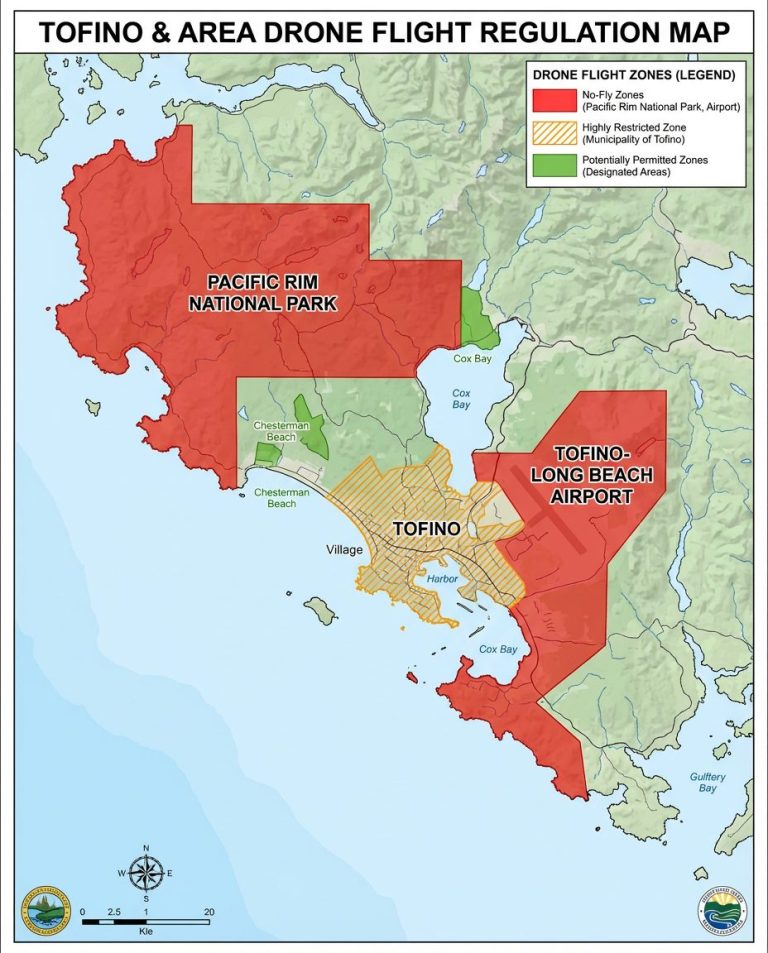
- Even parks, construction sites, and waterfronts may be controlled
- Altitude restrictions may change by location
- Airspace boundaries are not always intuitive
Flying legally requires checking airspace every time, even in familiar locations.
Common Misunderstandings About Controlled Airspace
“I’m Flying Low, So It Doesn’t Matter”
False. Controlled airspace applies from the surface upward unless otherwise specified.
“I’m Far from the Airport Runway”
Airspace extends far beyond runways, often several kilometres in every direction.
“My Drone App Says It’s Allowed”
Manufacturer apps may show advisory zones but are not regulatory authority.
“I’ve Flown Here Before Without Issues”
Past flights do not make an operation legal.
Advanced Does Not Mean Unlimited Freedom
Holding an Advanced certificate does not grant unrestricted access.
Advanced pilots must still:
- Obtain authorization where required
- Respect restricted and prohibited areas
- Maintain visual line of sight
- Avoid emergency operations
- Follow privacy and municipal laws
Advanced certification increases responsibility, not just privilege.
What Is Most Often Overlooked by Drone Operators
Several issues consistently cause confusion and enforcement action:
- Assuming Advanced certification alone allows controlled airspace flight
- Confusing manufacturer geofencing with legal authorization
- Ignoring heliports and water aerodromes
- Failing to recheck airspace for repeat locations
- Believing Basic pilots can receive authorization (they cannot)
- Flying near controlled airspace boundaries without buffer awareness
Understanding airspace is not optional; it is foundational.
How Airspace Knowledge Is Tested on Exams
Basic Exam Focus
- Recognizing uncontrolled vs controlled airspace
- Understanding basic separation distances
- Knowing when a flight is prohibited
- Interpreting simple airspace diagrams
- Understanding pilot responsibilities
Advanced Exam Focus
- Interpreting detailed aeronautical charts
- Understanding airspace classes and control zones
- Managing risks in controlled airspace
- Understanding authorization requirements
- Applying aviation decision-making principles
Advanced exams test judgment, not memorization.
Real-World Scenarios: Why This Knowledge Matters
Imagine a drone pilot hired to inspect a rooftop in a city. The building is:
- 8 km from an international airport
- 2 km from a hospital heliport
- Within a control zone
- Surrounded by bystanders
This operation:
- Is in controlled airspace
- Requires Advanced certification
- Requires authorization
- Requires careful altitude and distance management
Without understanding airspace, the pilot risks fines, certificate suspension, or worse.
Enforcement and Penalties
Violations related to airspace can result in:
- Monetary penalties
- Seizure of equipment
- Certificate suspension or cancellation
- Criminal charges in extreme cases
Transport Canada enforcement increasingly focuses on airspace violations due to public safety risk.
The Bigger Picture: Why Canada’s System Works This Way
Canada’s drone framework balances:
- Innovation
- Safety
- Commercial opportunity
- Public trust
- Aviation integration
Controlled airspace rules are not meant to restrict growth but to ensure drones can coexist safely with traditional aviation.
Pilots who understand airspace:
- Fly with confidence
- Earn trust from clients and regulators
- Reduce liability
- Operate professionally
Final Thoughts: Mastery Comes from Understanding Airspace
Advanced vs controlled airspace is not just an academic distinction. It determines:
- What you can do
- Where can you work
- How seriously regulators view your operation
- Whether your drone business can scale
If you fly drones in Canada, understanding controlled airspace is not optional; it is a core professional skill.
Knowledge of airspace is what separates casual pilots from competent operators, and competent operators from professionals.
The sky may look open, but it is structured, regulated, and shared. Knowing how that system works is what allows drone pilots to operate safely, legally, and successfully within it.
Free Uncontrolled VS Controlled Airspace Cheat Sheet
Controlled VS Uncontrolled Airspace Cheat Sheet
Controlled VS Uncontrolled Airspace Cheat Sheet