Basic vs Advanced RPAS Certification in Canada: The Complete Guide for Professional Drone Pilots
If you are new to operating drones in Canada or are looking into buying your first RPAS, you may already be overwhelmed by all the rules, regulations and misinformation that is out there.
I mean, it seems straight forward. You buy a drone, take it home, unbox it and take it out for a rip over the baseball stadium down the road.
Unfortunately, the reality is that operating a drone in Canada is not so simple.
Especially if you’re planning to use a drone for anything beyond casual flying in Canada, understanding the difference between Basic and Advanced RPAS certification is critical. This is especially true if your goal is to build a business, attract clients, and operate legally across a wide range of environments.
Drone regulations in Canada are governed by Transport Canada, and they follow a risk-based framework. Instead of separating drone use into recreational and commercial categories, Canada defines operations based on where and how you fly.
This is where Basic RPAS Certification and Advanced RPAS certifications come into play.
At first glance, the difference between the two may seem simple. In reality, it determines almost everything about your drone operations—from where you can legally fly, to what types of jobs you can accept, to how much revenue you can realistically generate.
For drone operators in regions like Northern British Columbia, where industries such as forestry, oil and gas, construction, and transportation dominate, the distinction between Basic and Advanced certification is not just important; it is foundational.
Understanding RPAS Certification in Canada
RPAS stands for Remotely Piloted Aircraft System, the official term used for drones in Canada.
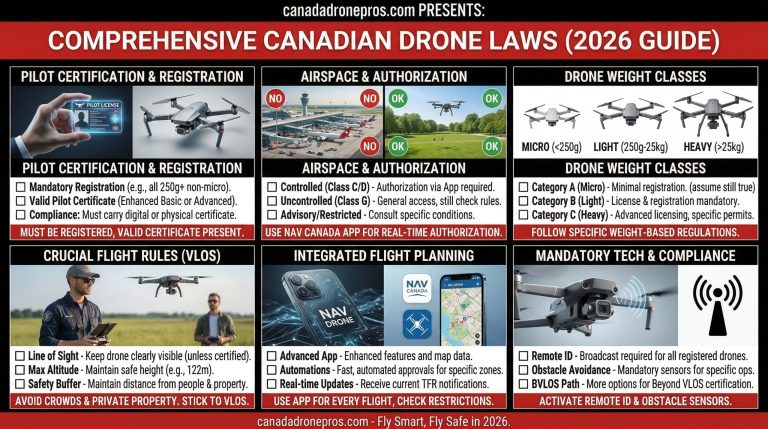
If your drone weighs between 250 grams and 25 kilograms, Canadian law requires you to:
- Register the drone
- Hold a valid pilot certificate
- Follow operational regulations
The certification you hold determines the level of operational complexity you are allowed to handle.
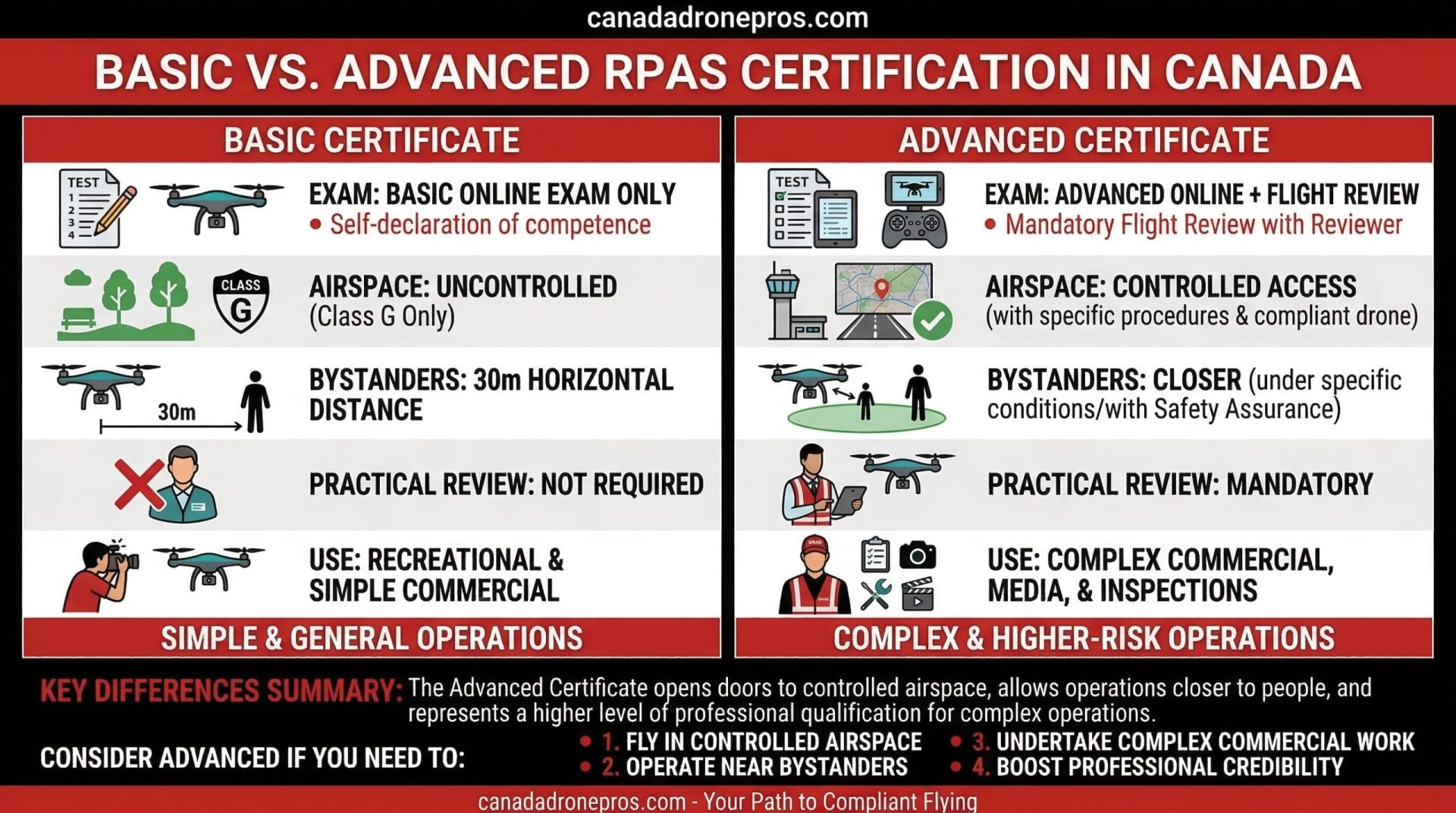
Basic certification is intended for low-risk operations in simple environments. Advanced certification is designed for more complex operations where risk factors increase due to proximity to people, infrastructure, or controlled airspace.
This distinction is what shapes the entire regulatory framework.
The Real Difference Between Basic and Advanced Certification
On paper, the difference between Basic and Advanced certification comes down to operational limitations, or how you plan on using your drone.
In practice, the difference is about freedom versus restriction.
Basic certification limits you to environments where risk is minimal.
Advanced certification gives you the flexibility to operate in environments where most real-world work actually exists.
Think of it this way:
Basic certification allows you to fly where it is easiest to fly.
Advanced certification allows you to fly where clients actually need you.
This is the core distinction that many new drone pilots underestimate.
Basic RPAS Certification: A Detailed Breakdown
Basic certification is the entry-level option for drone pilots in Canada.
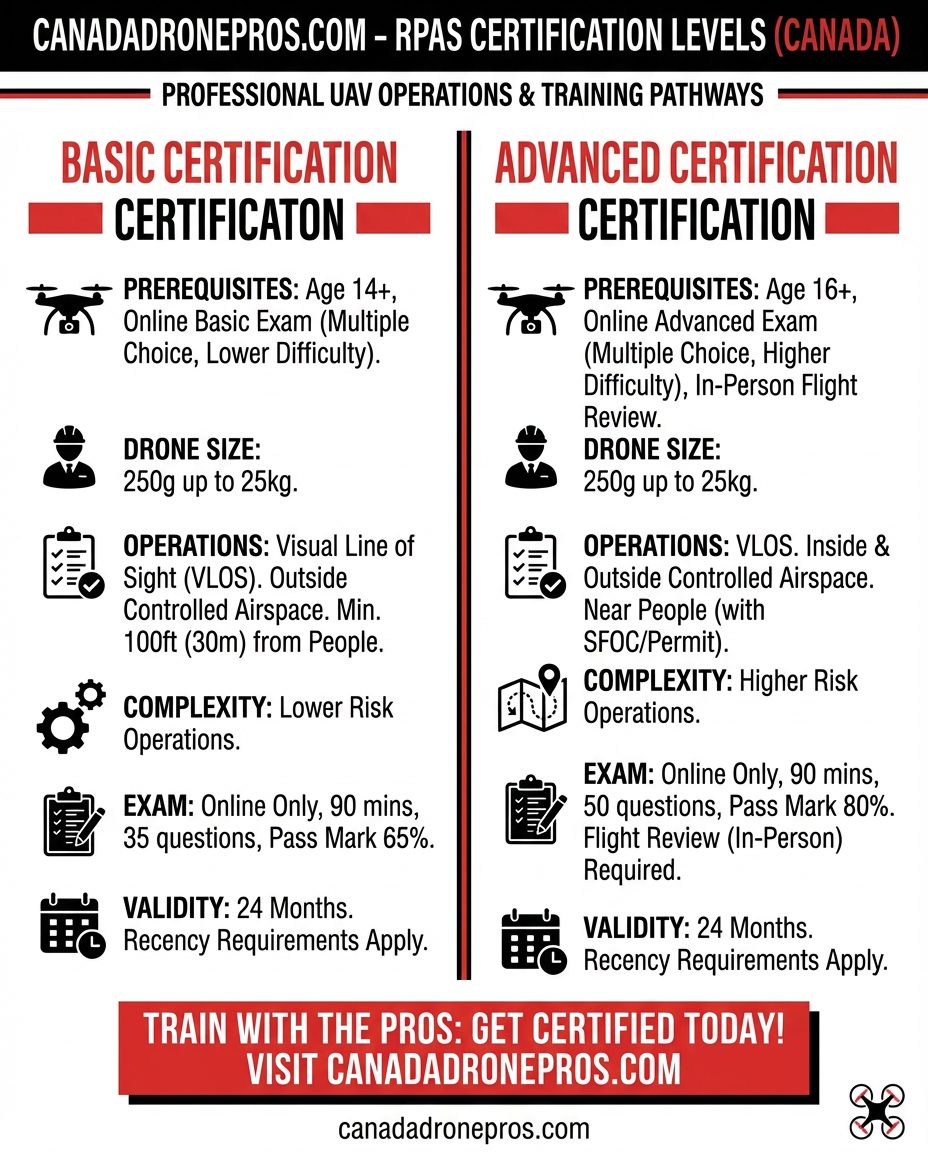
To obtain it, you must pass an online knowledge test administered by Transport Canada. There is no practical flight test required, which makes it accessible and relatively quick to achieve.
However, this accessibility comes with strict operational limitations that significantly affect your ability to perform commercial work.
Airspace Restrictions Under Basic Certification
One of the most significant limitations of Basic certification is airspace.
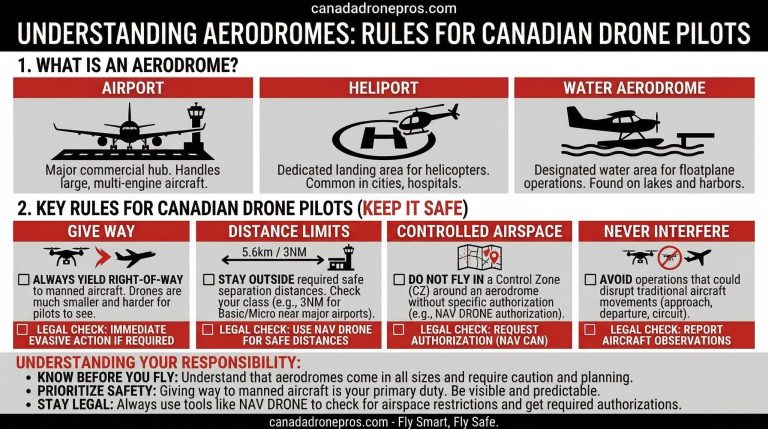
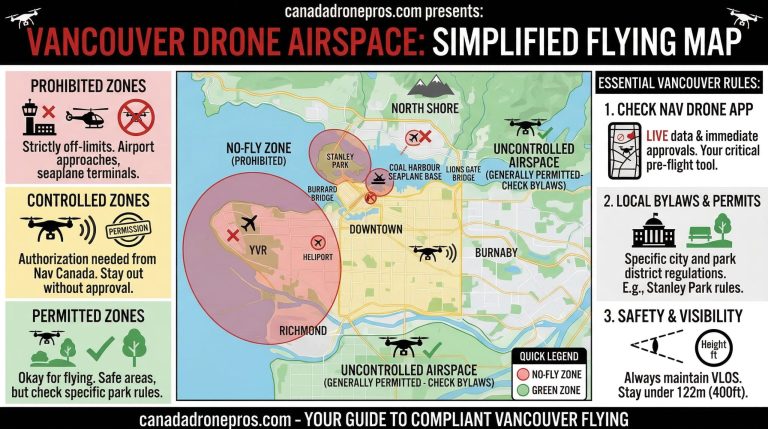
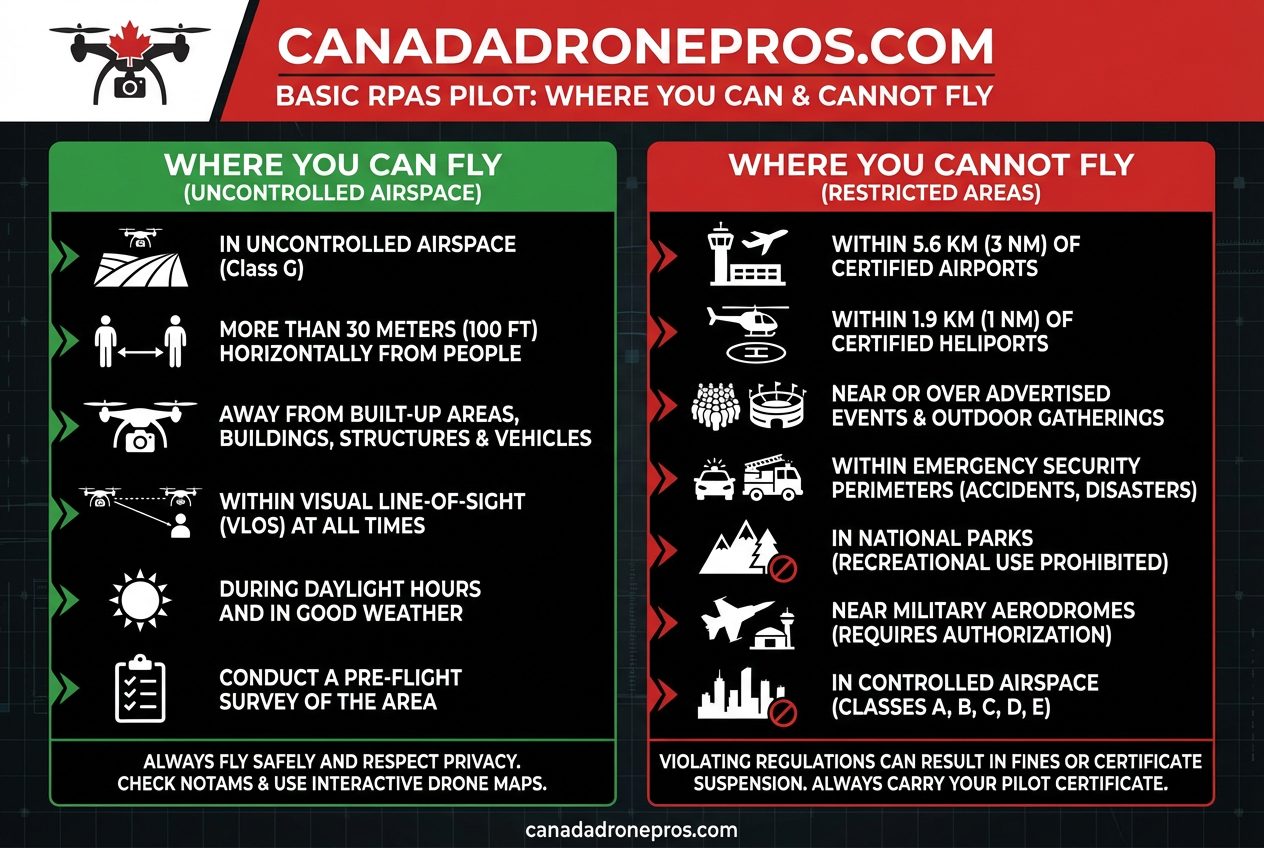
You are restricted to operating in uncontrolled airspace only. This means you cannot legally fly in controlled airspace under any circumstances.
Controlled airspace includes:
- Areas around airports
- Most towns and cities
- Regions with active aviation traffic
This is where many pilots run into problems.
You may look at a small town and assume it is unrestricted, but in reality, many smaller communities are still within controlled airspace zones. Without Advanced certification, you cannot legally operate in those areas.
Distance From People: A Major Limitation
Basic certification requires you to maintain a minimum horizontal distance of 30 metres from bystanders.
You cannot fly over people at any time.
This restriction may seem manageable, but in real-world scenarios, it becomes a major limitation.
For example:
- Shooting a business exterior becomes difficult if people are nearby
- Filming a construction site may be impossible if workers are present
- Capturing a real estate listing in a populated area becomes restricted
Even a single person walking into your shot can put you out of compliance.
Where Basic Certification Works Best
Despite its limitations, Basic certification is still useful in certain scenarios.
It works well for:
- Remote landscape photography
- Forestry and environmental documentation
- Rural property shoots
- Backcountry exploration content
In Canada, this might include:
- Logging roads
- Remote camps
- Isolated industrial sites far from infrastructure
If your work is entirely in these environments, Basic certification may be sufficient.
The Commercial Limitations of Basic Certification
The biggest drawback of Basic certification is its impact on your ability to generate income.
Most paying clients are located in:
- Towns and cities
- Industrial zones
- Areas near infrastructure
These locations often fall within controlled airspace or involve proximity to people.
As a result, many Basic-certified pilots quickly find themselves unable to legally accept common jobs such as:
- Real estate photography
- Commercial business videos
- Urban marketing content
- Industrial site documentation
This creates a ceiling on growth.
Advanced RPAS Certification: A Complete Breakdown
Advanced certification is designed for pilots who need to operate in more complex and demanding environments.
To obtain Advanced certification, you must:
- Pass a more advanced knowledge exam
- Complete a flight review with a certified examiner
The flight review is what sets Advanced certification apart. It ensures that you can safely handle real-world scenarios, not just theoretical knowledge.
Controlled Airspace Access: The Biggest Advantage
One of the most important benefits of Advanced certification is the ability to operate in controlled airspace with authorization.
This allows you to work in:
- Cities
- Towns
- Industrial areas
- Locations near airports
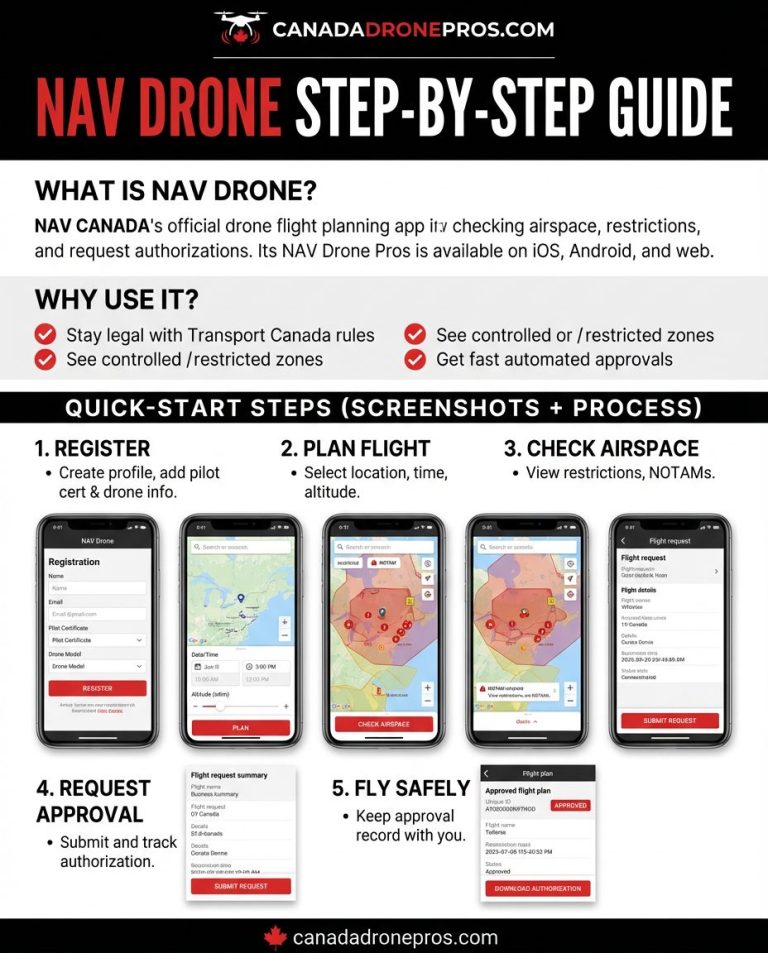
Authorization is typically obtained through tools like NAV Drone.
This capability alone opens up the majority of commercial opportunities.
Operating Near People
Advanced certification allows you to operate much closer to people than Basic certification.
In many cases, you can fly as close as 5 metres horizontally, depending on your drone and the situation.
With the appropriate drone, you can also conduct operations over people.
This dramatically expands your ability to:
- Capture dynamic footage
- Work in populated environments
- Produce high-quality commercial content
These are the types of projects that clients are willing to pay for.
Real-World Examples: Basic vs Advanced in BC
To understand the difference in practical terms, consider the following scenarios.
A logging company wants aerial footage of trucks moving through a corridor near a highway. With Basic certification, maintaining a 30-metre distance from vehicles and workers may be difficult. With Advanced certification, you have more flexibility.
A real estate agent wants a drone video of a home in a residential neighborhood. Basic certification likely prevents you from flying there due to controlled airspace and proximity to people. Advanced certification allows it with proper authorization.
A construction company needs progress updates on a site within city limits. Basic certification cannot legally operate there. Advanced certification can.
These examples highlight how Advanced certification directly translates into more opportunities.
Equipment Considerations for Advanced Operations
Holding an Advanced certificate is only part of the equation.
Your drone must also meet Transport Canada’s requirements for operating near people or in controlled environments.
This means:
- Not all drones are approved for all operations
- You must understand your drone’s classification and limitations
Many modern drones are designed with these requirements in mind, but it is still your responsibility to verify compliance.
Responsibility and Professional Standards
Advanced certification comes with increased expectations.
You are expected to:
- Conduct thorough pre-flight planning
- Assess risks before each operation
- Understand airspace classifications
- Communicate when necessary
This level of responsibility is what separates professional operators from hobbyists.
Clients also recognize this difference, which can impact your credibility and pricing.
Visual Line of Sight Requirements
Both Basic and Advanced operations require you to maintain visual line of sight with your drone.
This means you must be able to see the drone at all times without relying solely on your screen.
In environments like forests, mountainous terrain, or industrial sites, maintaining line of sight can be challenging and must be carefully managed.
When Advanced Certification Is Not Enough
There are situations where even Advanced certification is not sufficient.
These include:
- Beyond visual line of sight operations
- Heavy drone operations
- High-risk environments
In these cases, you must apply for additional authorization from Transport Canada.
Choosing Between Basic and Advanced Certification
If your goal is casual flying or working exclusively in remote areas, Basic certification may be enough.
However, if you plan to:
- Work with clients
- Operate in populated areas
- Build a professional portfolio
- Grow a business
Advanced certification is the better choice.
Cost vs Long-Term Value
Basic certification is easier and less expensive to obtain.
Advanced certification requires more time, effort, and investment.
However, the long-term value of Advanced certification is significantly higher.
It allows you to:
- Access a wider range of jobs
- Increase your earning potential
- Build a sustainable business
For most serious operators, the investment pays off quickly.
Common Mistakes Drone Pilots Make
As a new drone operator, it can be overwhelming to decide exactly which licence you will need to operate, or if you will even need one at all. This results in Many pilots starting with Basic certification and quickly realizing its limitations in comparison to what they had hoped to accomplish.
Other newbies fail to check the airspace before accepting professional jobs, leading to cancelled projects or serious legal issues.
Some others may assume that owning a high-end drone automatically allows advanced operations, which is certainly not the case and can be a costly mistake.
This is precisely why knowing the regulations and understanding both certification and equipment requirements is essential for success. Reading this article and website will give new drone users in Canada a solid understanding of the laws, licensing, and which certification works best for them.
The Future of Drone Regulations in Canada
Drones aren’t going anywhere. In fact, UAV’s are only going to get more popular! As drones continue to expand across more industries including medicine, policing, and national defence, we are sure to see regulations rapidly evolve. While the most recent update to the rules was in November of 2025, regulators continue to keep an eye on the industry as a whole.
Currently, across North America and particularly here at home in Canada, there is a growing focus on:
- Advanced operations
- Integration with traditional aviation systems
- Expanded commercial use
This trend suggests that Advanced certification will become even more important over time.
Final Thoughts
The difference between Basic and Advanced RPAS certification in Canada goes far beyond passing a test. It defines your capabilities, your opportunities, and your potential as a drone operator.
Basic certification is suitable for low-risk, remote operations.
Advanced certification is essential for professional work in real-world environments, especially in industries like real estate, construction, forestry, and industrial marketing.
If your goal is to build a serious drone business and operate at a professional level, Advanced certification is not just an option—it is a necessity.
Now that you know the difference between Basic vs Advanced RPAS Certification in Canada, check out our professional Transport Canada drone courses here!