Drone Laws in British Columbia: Where You Can and Can’t Fly
By Canada Drone Pros
British Columbia is one of Canada’s most breathtaking provinces to explore by air. Coastal fjords, dense rainforests, alpine peaks, urban skylines, farmland, and remote wilderness all exist within a few hours of each other.
That variety also makes British Columbia one of the most complex provinces for drone laws.
At Canada Drone Pros, we see more enforcement issues in BC than almost anywhere else in Canada. The reason is simple: federal airspace rules, provincial park restrictions, municipal bylaws, and conservation land protections overlap heavily.
This guide explains British Columbia drone laws in plain language. You’ll learn who regulates drone use, where drones are prohibited, where they may be allowed, how Transport Canada rules apply, and how to plan legal flights anywhere in BC.
Who Regulates Drone Use in British Columbia?
Drone use in British Columbia is governed by three layers of authority.
1. Transport Canada (Federal Airspace Rules)
Transport Canada regulates all airspace in Canada, including British Columbia.
These federal rules cover:
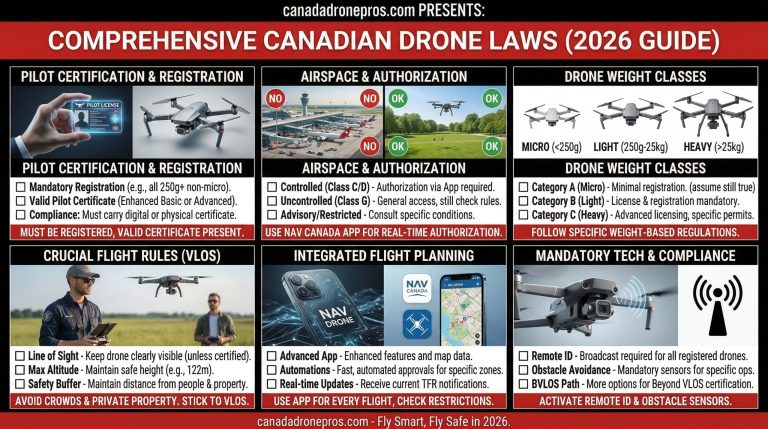
- Drone registration
- Pilot certification (Basic or Advanced)
- Maximum altitude (400 feet AGL)
- Visual line of sight
- Operations near people
- Controlled airspace authorization via NAV CANADA
If your drone weighs 250 grams to 25 kilograms, you must follow these rules anywhere you fly.
2. Land Managers (Parks, Protected Areas, Property)
Airspace approval does not grant permission to take off or land.
In BC, land managers include:
- Parks Canada (National Parks & National Historic Sites)
- BC Parks (Provincial Parks & Protected Areas)
- Municipal governments
- Regional districts
- Private landowners
- Indigenous Nations
Each can restrict or prohibit drone operations on the land they manage.
3. Municipal Bylaws (Cities & Regional Districts)
Cities across BC often prohibit drone use in:
- City parks
- Beaches
- Waterfront areas
- Sports fields
- Urban green spaces
- Event locations
Municipal rules commonly restrict launching and landing, even if the airspace is legal.
National Parks in British Columbia: No Recreational Drones
BC contains several national parks, including:
- Pacific Rim National Park Reserve
- Glacier National Park
- Yoho National Park
- Kootenay National Park
- Mount Revelstoke National Park
Recreational drone use is prohibited in all national parks.
This ban applies to:
- All drone sizes
- Takeoff, landing, and overflight
- Visitors and locals alike
Parks Canada enforces these restrictions under the Canada National Parks Act, with fines that can reach up to $25,000.
Commercial drone operations are possible only with:
- Parks Canada filming permits
- UAV authorization
- Full Transport Canada compliance
Approvals are rare and tightly controlled.
Provincial Parks & Protected Areas in BC
BC Parks manages:
- Provincial Parks
- Conservancies
- Ecological Reserves
- Protected Areas
- Recreation Areas
Recreational Drones
BC Parks generally prohibits recreational drone use unless specifically authorized.
Many iconic locations such as:
- Garibaldi Provincial Park
- Joffre Lakes Provincial Park
- Cathedral Provincial Park
- Strathcona Provincial Park
are no-drone zones for recreational use.
Commercial & Research Use
Commercial drone operations may be approved with:
- Written authorization from BC Parks
- Site-specific restrictions
- Environmental and wildlife mitigation plans
Municipal Drone Rules in British Columbia
Municipal bylaws are one of the most common enforcement traps in BC.
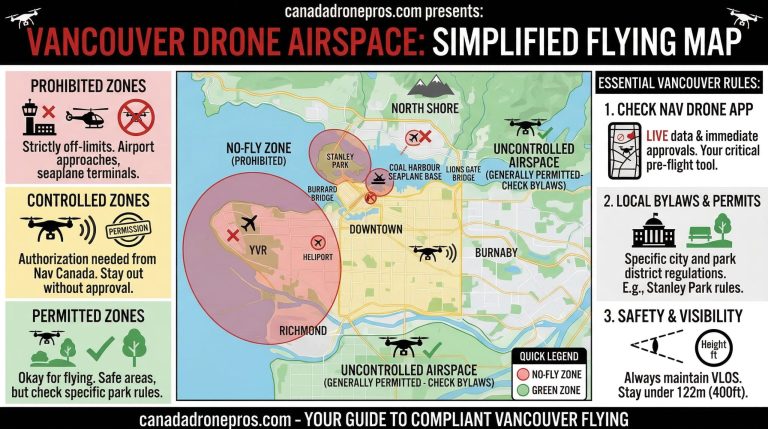
Vancouver
- Drones are prohibited in most city parks and beaches
- Strict enforcement near Stanley Park and waterfronts
- Controlled airspace due to heliports and seaplanes
Victoria
- Restrictions in city parks and Inner Harbour
- Heavy seaplane traffic complicates the airspace
Whistler
- Drone use is restricted in resort areas and municipal lands
- Provincial park boundaries nearby add complexity
Smaller Communities
Even small towns often ban drones in:
- Parks
- Beaches
- Community spaces
Always check local bylaws before flying.
Controlled vs Uncontrolled Airspace in BC
BC’s terrain creates complex airspace patterns.
Controlled Airspace
Common around:
- Vancouver International Airport (YVR)
- Victoria International Airport (YYJ)
- Kelowna (YLW)
- Abbotsford (YXX)
- Heliports and floatplane bases
Advanced certification and NAV CANADA authorization are required.
Uncontrolled Airspace
Found in:
- Rural valleys
- Interior regions
- Agricultural areas
- Remote coastline
Basic pilots may fly here when all rules are met.
Transport Canada Rules BC Pilots Must Follow
All flights outside prohibited land must follow federal law.
Registration
Drones between 250g and 25kg must be registered and marked.
Pilot Certification
- Basic Certificate: Uncontrolled airspace, far from people
- Advanced Certificate: Controlled airspace and closer operations (with approved aircraft)
Altitude & Visibility
- Maximum 400 feet AGL
- Visual line of sight required
- Night flights require proper lighting
Safety
- Maintain separation from bystanders
- Avoid wildlife disturbance
- Do not endanger aircraft or people
Violations can result in significant fines.
Where You Can Fly Drones in British Columbia
Despite restrictions, legal drone flying is possible in BC with careful planning.
Potential legal areas include:
- Private land (with permission)
- Agricultural land
- Industrial zones
- Rural Crown land outside protected areas
- Municipal areas that explicitly allow drones
Always verify:
- Airspace legality
- Landowner permission
- Compliance with federal rules
Essential Flight Planning Tools for BC
Canada Drone Pros recommends:
- NRC Drone Site Selection Tool
- Transport Canada “Where You Can Fly” guidance
- NAV CANADA RPAS authorization system
Use all three together.
Common Drone Mistakes in British Columbia
We frequently see pilots:
- Flying in provincial parks unknowingly
- Launching from beaches or waterfront parks
- Ignoring municipal bylaws
- Flying near seaplane routes
- Assuming sub-250g drones are exempt
Education prevents nearly all issues.
Drone Fines & Enforcement in BC
Penalties can stack from multiple authorities:
- Parks Canada: fines up to $25,000
- BC Parks: tickets and removal
- Municipal bylaw fines
- Transport Canada aviation penalties
Social media posts have triggered enforcement after the fact.
Responsible Drone Etiquette in BC
Professional drone pilots go beyond minimum compliance.
- Avoid wildlife and nesting areas
- Keep wide buffers from people
- Respect Indigenous lands and signage
- Minimize noise impacts
- Choose low-traffic times
Responsible flying protects access for everyone.
Frequently Asked Questions: BC Drone Laws
Are drones legal in British Columbia?
Yes — when flown legally under federal, provincial, and municipal rules.
Can I fly in BC provincial parks?
Recreational drones are generally prohibited.
Do microdrones bypass park rules?
No. Land restrictions still apply.
Can international visitors fly drones in BC?
Only if they meet Canadian registration and certification requirements.
Can I fly at night in BC?
Yes, if you comply with Transport Canada rules.
Final Thoughts on Drone Laws in British Columbia
British Columbia rewards careful planning — and punishes assumptions.
Most enforcement issues happen because pilots didn’t realize the land they were standing on was restricted.
If you understand who controls the airspace, who controls the land, and how Transport Canada rules apply, BC offers incredible opportunities to fly legally and responsibly.
For Transport Canada certification prep, BC-specific training, and professional drone education, Canada Drone Pros is here to help you fly confidently anywhere in British Columbia.